Competitive Intelligence
An aggregator that does the work nobody was going to do.
Multi-API signal ingestion, Claude-powered synthesis, ready-to-use competitive briefings.
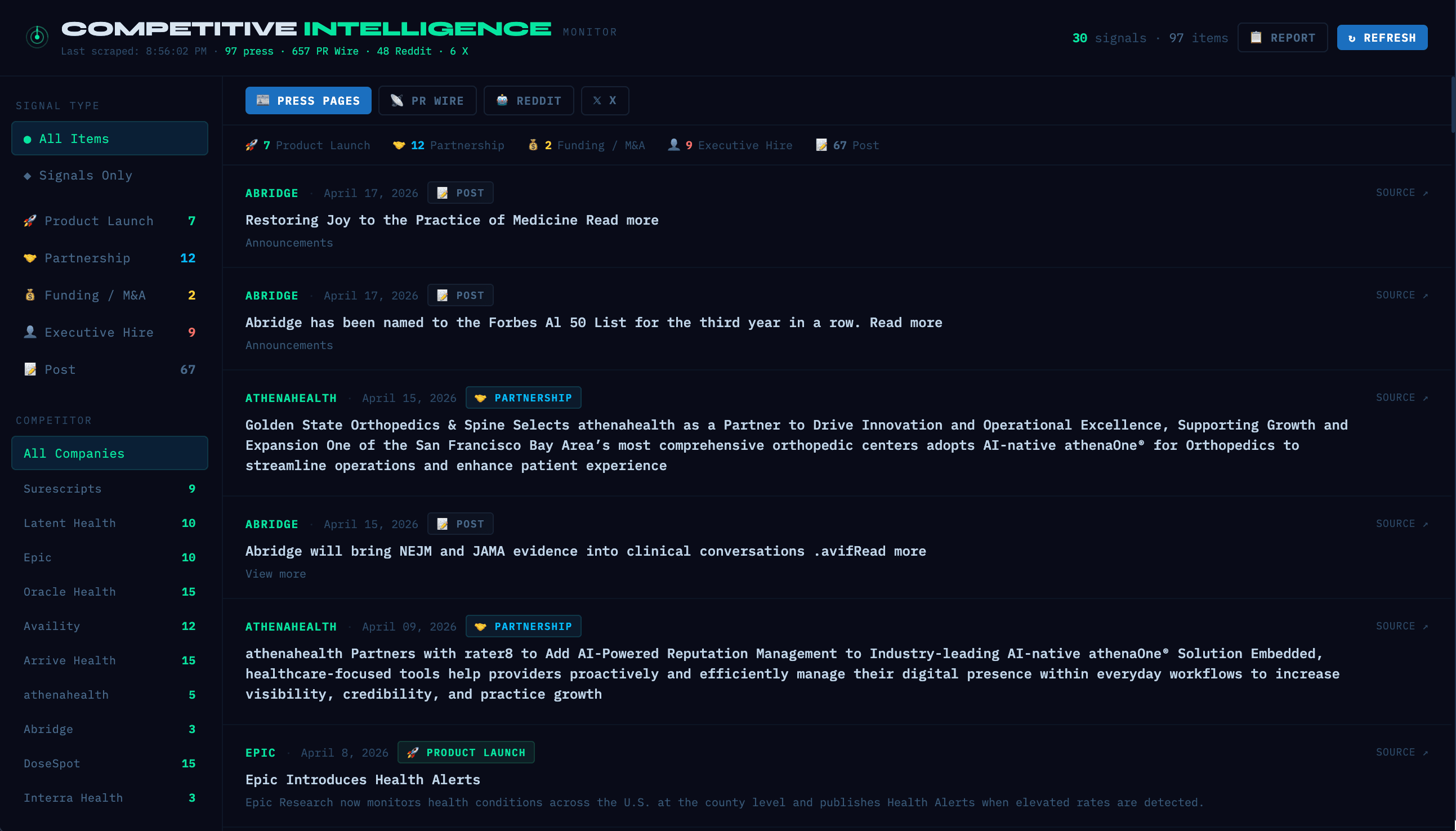
Competitive intel that runs on a schedule.
I built this because the manual version was eating hours and still missing things. Every product marketer knows the ritual: check competitor sites, comb LinkedIn, scan Reddit, scroll X, pull Gartner, try to synthesize it into something a sales team can use before the next conference.
This is a web app that does the scanning, pulls the signals, and uses Claude to synthesize everything into competitive briefings. The team uses it leading into conferences and sales cycles.
Production tool. Not a prompt template.
Competitive intelligence has three structural problems.
High-effort, low-frequency
Nobody has time for weekly CI, so it happens right before conferences or launches, when it's most stressful and least rigorous.
Fragmented sources
Website scrapes, LinkedIn, X, Reddit, review sites, earnings transcripts. Each one lives in a different tool. Synthesis is manual.
Output nobody reads
Good CI ends up as a PDF that dies in a Slack channel. Sales never finds it at the moment they need it.
The app solves all three by making ingestion automated, synthesis instant, and output modular.
Three layers. Signal in, briefing out.
Data layer
Jina Reader
Structured web scraping for competitor blogs, product, pricing.
Firecrawl
Deeper site crawls and content discovery.
X API
Competitor handle activity and industry chatter.
Reddit API
Practitioner sentiment in target subreddits.
Intelligence layer
Claude API
Synthesis engine. Structured outputs feed against stored brand and positioning context.
Prompt schema
Few-shot examples from real briefings. Tight output schema for battlecards.
Feedback loop
Sales reps flag useless output. Schema tightens. Output improves.
Output layer
Battlecards
Per-competitor, ready for the rep in a live call.
Conference briefings
Bundle of intel timed to a specific event.
Weekly digests
Scheduled synthesis. Signal up, noise down.
Ad-hoc deep dives
One-off investigation when a new competitor surfaces.
The tool is live. Go use it.
Running in production on the same hosting stack as this site. Opens in a new tab.
Live URL
ci-avenger.vercel.app
“Hire me into a PMM or growth role, and within the first 60 days I'll have a version of this running against your competitors.”
I didn't build this to prove I can use AI.
The competitive intel function at most companies is a spreadsheet, a Google Doc, and a person's memory. I replaced all three with something that runs on a schedule.
The hardest part wasn't the APIs. It was the prompt engineering for synthesis. Raw competitor data is noise. Getting Claude to output a battlecard a rep can actually use in a call required tight schema design, few-shot examples from real briefings, and an iteration loop where sales reps told me when the output was useless.
That feedback loop is the product.
A senior PMM, growth, or head of marketing seat where the function is mine to own.
Available immediately. Remote-first, open to Chicago onsite. Targeting healthtech, B2B SaaS, and cybersecurity at Series B through public.